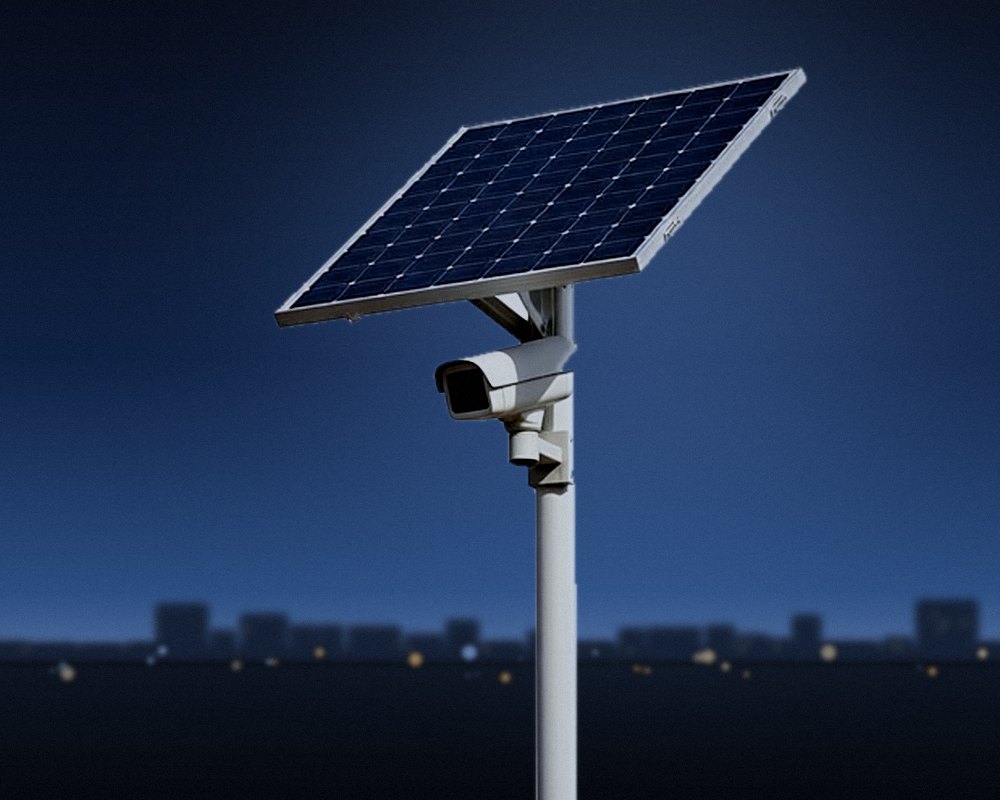
A solar-powered license plate reader is a camera that reads plates using its own solar panel and battery, with no connection to the power grid. It can be mounted wherever a pole, mast or trailer can go and typically reports over cellular data. Intelvi AI units add continuous video, so agencies get the full scene and not only the plate.
What a solar-powered license plate reader is
A solar-powered license plate reader is a camera that reads vehicle plates using the energy it collects from its own solar panel, stored in a battery. You will also see it called a solar ALPR camera, a solar LPR camera or, outside the US, a solar ANPR camera: the names differ, the technology is the same. Because it needs no connection to the electrical grid, it can be mounted on a pole, mast or trailer in places where running power would be slow or expensive: rural road junctions, city gateways, parks, trails, bridges and temporary hot spots.
Put simply, solar powered license plate recognition means the camera makes its own power. The same idea is often called an off-grid ALPR camera (automated license plate recognition). The panel and battery solve the power problem; a cellular connection usually solves the network problem, so the unit can send reads, alerts and video to the cloud without a cable. Intelvi AI units follow this model and add something most plate readers do not: continuous video of the whole scene, recorded around the clock, not just a cropped still of the plate.
Why agencies choose off-grid cameras
For most agencies the camera is the easy part. The hard part is everything around it. Hard-wired readers typically involve utility coordination, trenching, conduit, electrical permits and sometimes a separate meter. Each of those steps adds weeks or months, and each one is a place where a project stalls.
No trenching or utility hookup
Mount the unit on an existing pole or a new one and switch it on. Coverage is not limited to places where a power drop already exists.
Faster path to coverage
Fewer permits and contractors between a council vote and a working camera, which matters when a corridor is already a problem.
Flexible as hot spots move
Because nothing is buried, a camera can be relocated when crime patterns change. Rapid-deploy and mast options are built for this.
Resilience
A self-powered unit keeps recording through local outages that would take a hard-wired site offline, provided the battery is sized for the site.
How a self-powered camera works
Every solar camera is the same four systems working together, and each one is worth understanding because each is a place a poorly designed unit can fail.
- Solar panel. Sized to the camera’s power draw and to the sunlight at your latitude. Winter sun hours, not summer, decide whether it works year-round.
- Battery. Carries the camera through the night and through cloudy stretches. Its capacity sets how many days the unit can run with little or no sun.
- Camera and AI. Computer vision finds the vehicle, locks onto the plate and reads it in real time. Intelvi AI also records continuous video so investigators see what happened before and after each read.
- Connectivity. Reads and alerts travel to the cloud over a cellular link. Check coverage at the exact pole location before you commit.
The platform behind the camera then does the work agencies actually care about: matching plates against hotlists, sending instant alerts, and letting investigators search from a partial plate to the exact camera and moment.
What to check before you buy
Solar is mature technology, but sizing and siting decide whether a camera performs. Ask any vendor, including us, the following before you sign.
| Question | Why it matters |
|---|---|
| How many days can it run with no sun? | Battery autonomy is the number that protects you from a week of storms. Ask for it at your latitude, in winter. |
| Is the site shaded? | Trees, buildings and poles can cut panel output sharply. A site survey should check the sun path across the year. |
| What is the network plan? | A solar camera still needs data. Confirm carrier coverage at the pole and what happens when the link drops. |
| How is it mounted and secured? | Height, hardware and tamper resistance determine vandalism and theft risk. Ask about wind loading for exposed sites. |
| Who installs and maintains it? | With a subscription model, installation, repairs and replacements should be included. Intelvi AI handles all three. |
| What happens at night and in bad weather? | Ask to see sample reads from real nighttime and rain deployments, not just daytime demos. |
Solar power is now a standard option in this category: several established vendors offer it. What should decide your choice is what the camera captures, how it is supported and how the data is governed. See our guide to choosing a reader.
Four ways to deploy off-grid
Off-grid power makes four deployment styles practical. Each is available from Intelvi AI, and many agencies mix them.
Fixed
Permanent, solar-powered pole units for corridors, intersections and city gateways. Always on, always recording.
Patrol
Turns a patrol vehicle into a moving sensor that reads plates on the move and flags hits as they happen.
Rapid-deploy
Self-contained units that relocate as hot spots shift. Built for events, active investigations and temporary coverage.
Mast
Telescoping masts lift the camera for commanding views over lots, perimeters and large gatherings.
See every option on the deployments section of our home page.
Why video matters as much as the plate
A plate read tells you that a vehicle passed a point. It does not tell you who was in it, whether it was following another car, or what happened a minute later. That is why Intelvi AI records continuous video alongside every read: a plate is a clue, and video is the story.
For the same reason, a camera that only snaps a still when it detects a plate can miss the events around it. Continuous recording gives investigators and prosecutors the surrounding context. Read more in how AI license plate recognition works and how police use it.
Frequently asked questions
Do solar-powered license plate readers work at night?
Yes. The battery stores the day’s solar energy and powers the camera and its infrared illumination overnight. Ask any vendor for sample reads from real night deployments at similar sites.
How long can a solar camera run without sunlight?
It depends on battery capacity, the camera’s power draw and local conditions. Ask for the autonomy figure in days at your latitude in winter. Intelvi AI sizes the system to the site during the survey.
Does an off-grid camera need Wi-Fi or an internet connection?
It needs a data link, which is usually cellular. Confirm coverage at the exact mounting location before you commit.
Can the camera be moved to a new location?
Yes. Rapid-deploy and mast units are designed to relocate as hot spots shift, and fixed units can be moved by our installation team.
How much does a solar license plate reader cost?
Public contract documents show turnkey ALPR subscriptions in the range of roughly $2,000–$3,000 per camera per year. See our ALPR cost and pricing guide for sources and a total-cost checklist.
What is a solar ALPR camera?
A solar ALPR (automated license plate recognition) camera is a license plate reader powered by its own solar panel and battery instead of the electrical grid. “Solar LPR camera,” “solar license plate recognition camera” and “solar ANPR camera” all describe the same kind of device.
Is a solar license plate reader the same as a portable or mobile one?
Not always. Solar describes how the unit is powered. Portable and mobile units are defined by how they move: a rapid-deploy unit or mast that relocates, or a reader mounted on a patrol vehicle. Many portable units are solar powered; Intelvi AI offers fixed, patrol, rapid-deploy and mast deployments.
Is solar ALPR only for rural areas?
No. Cities use it for gateways, parks, trails and temporary coverage, anywhere that adding power would be slow or costly. See license plate readers for cities and counties.